
The ruling of the EuGH (European Court of Justice) in the case "Avoir fiscal" (Case 270/83) from 1986 is a pioneering landmark ruling in the field of direct taxes, because it clarified for the first time the application of EU fundamental freedoms in the context of direct taxation.
Facts of the case: The case concerned the discrimination against foreign insurance companies by the French tax credit system, which did not grant these companies the same right of imputation as domestic companies. The French government granted a so-called "avoir fiscal" (tax credit) for dividends distributed by French companies. However, this tax credit was only granted to domestic companies, while branches and agencies of companies resident in other Member States were excluded from it.
The subject of the infringement proceedings against France was the disadvantage faced by insurance companies from other Member States that maintained permanent establishments in France. The permanent establishments of the foreign insurance companies held stakes in French subsidiary corporations. The permanent establishments were denied the imputation of the corporate income tax paid at the level of the French subsidiary (avoir fiscal). In contrast, French corporations were entitled to the imputation of the corporate income tax levied at the level of their French subsidiary.
The European Commission sued France, arguing that this practice violated the freedom of establishment according to Art. 52 EEC Treaty (now Art. 49 TFEU), as it constituted discrimination against companies from other Member States wishing to establish themselves in France. The EuGH ruled that this practice constituted an inadmissible restriction on the freedom of establishment and thus violated EU law.
This ruling was groundbreaking because it paved the way for the application of fundamental freedoms to national tax law, even though direct taxes generally fall within the competence of the Member States. It clarified that EU fundamental freedoms also play a significant role in the field of direct taxes and that discrimination based on the seat of a company within the EU is inadmissible. The ruling strengthened the importance of the freedom of establishment and laid the foundation for more uniform tax treatment within the EU.
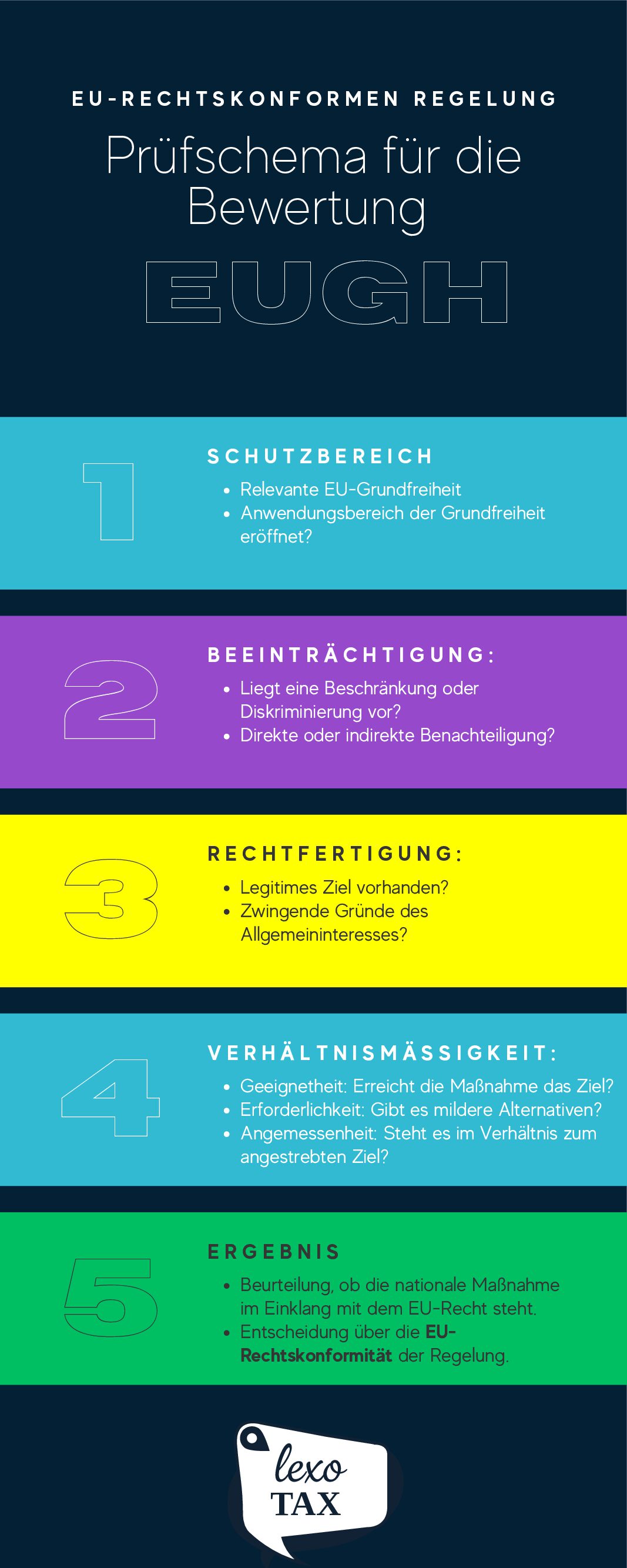
The examination scheme for assessing an EU law-compliant regulation based on the ruling of the EuGH in the Avoir fiscal case (Case 270/83) is presented as follows:
1. Scope of Protection
- First, it is examined whether the facts fall within the scope of protection of one of the EU fundamental freedoms. In the Avoir fiscal case, this was the freedom of establishment (Art. 49 TFEU). This freedom includes the right of companies and firms to establish themselves in another EU Member State and to be economically active there. It is also examined whether a secondary establishment (such as a subsidiary or a permanent establishment) is affected.
2. Impairment
- It is examined whether the national measure impairs the scope of protection of the freedom of establishment. In the Avoir fiscal case, the different tax treatment of domestic and foreign companies led to overt discrimination (differentiation by seat) and violates the freedom of establishment. The possibility of covert discrimination is also considered. The question here is whether the regulation disadvantages foreign companies in practice. Among other things, there is a requirement for national treatment (equality) of companies from other Member States.
3. Justification
- An impairment of fundamental freedoms can be justified if it serves a legitimate objective and is proportionate. In the Avoir fiscal case, the lack of harmonisation (i.e., no transferred competence) of direct taxes at the EU level was considered as a possible justification but was ultimately rejected because the freedom of establishment is unconditional. The French government had tried to justify the regulation with various arguments, including the possibility of offsetting advantages and the lack of EU competence in the field of direct taxes. It was also examined whether a difference in treatment could be balanced by a Doppelbesteuerungsabkommen (DBA) (Double Taxation Agreement), but this was insufficient. The EuGH rejected all these arguments and ruled that there was no justification for the unequal treatment.
4. Proportionality
- Finally, it is examined whether the national measure is proportionate, i.e., whether it is suitable, necessary, and appropriate to achieve the intended objective. In the Avoir fiscal ruling, the EuGH concluded that the French government's measure was not proportionate, as it went beyond what was necessary to achieve the objective. The regulation was therefore not compliant with EU law.
The EuGH ruling in the Avoir fiscal case (Case 270/83) from 1986 is considered a pioneering landmark ruling in the field of direct taxes. Here are the main reasons for this:
- Overcoming the lack of competence: For the first time, the EuGH applied EU fundamental freedoms to the area of direct taxes, even though the EU originally had no explicit competence in this area. In doing so, the EuGH sent a clear signal that fundamental freedoms can also apply to national tax regulations.
- Fundamental importance of the freedoms: The ruling made it clear that the fundamental freedoms of the Treaty (such as the freedom of establishment) apply without restriction in the field of direct taxes. This led to a wide-ranging integration of tax law into the scope of application of EU law.
- Literal interpretation and no sectoral exemption: The EuGH refused to allow an exception to the fundamental freedoms for the area of direct taxes. It applied a strict literal interpretation of the treaties, which confirmed the validity of the fundamental freedoms in tax law.
- Discrimination in tax law: The ruling recognised that discrimination based on the seat of a company is just as inadmissible as discrimination based on nationality. This led to stronger equal treatment of domestic and foreign companies in tax law.
- Equalisation of seat and nationality: The EuGH found that the seat of a company must be equated with a natural person in tax law, meaning that different tax treatments based on the seat are considered indirect discrimination.
The court emphasised that the freedom of establishment applies unconditionally and universally and that national regulations restricting this freedom can only be justified under very strict conditions.
In summary, the ruling is considered groundbreaking because it paved the way for the application of EU fundamental freedoms to national tax law and significantly strengthened the importance of these freedoms in the context of direct taxes.
**
Note
**This article is for general information purposes and was carefully prepared by the Lexo.Tax editorial team. Personal tax advice can only be provided within the framework of membership with lexo.tax – and exclusively to the extent legally permitted under § 4 Nr. 11 StBerG (Tax Consultancy Act).