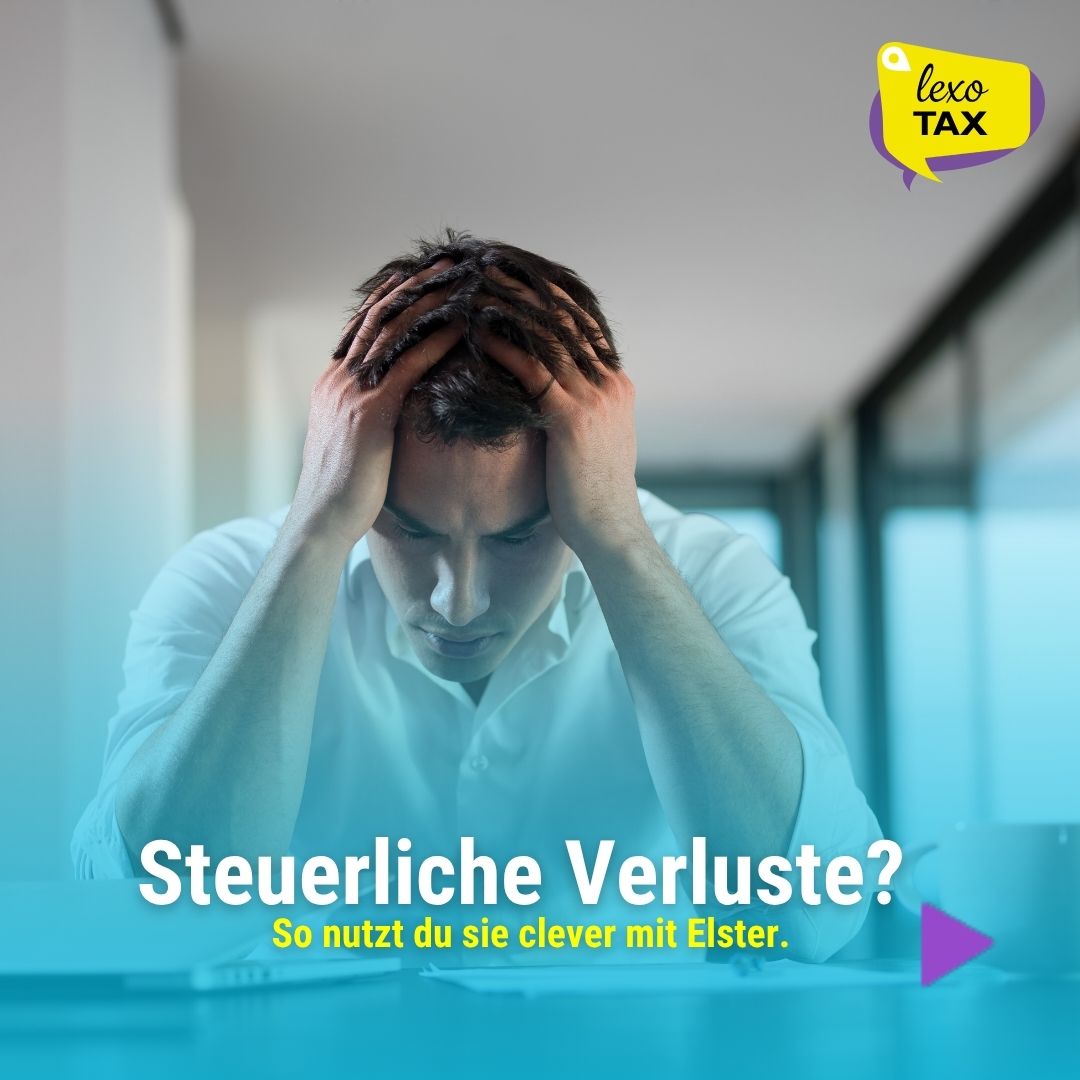
When you make a loss – for example, through self-employed activities, stock market transactions, or high income-related expenses – your first thought might be frustration. But: such losses can be utilised for tax purposes. The tax authorities allow you to either carry them back into the past or carry them forward into the future. This is called Verlustrücktrag (loss carryback) or Verlustvortrag (loss carryforward).
In this article, we explain in simple terms:
-
What the difference is between loss carryforward & loss carryback
-
When each path makes sense
-
How to correctly enter both in ELSTER step by step


What is a Loss Carryback (Verlustrücktrag)?
With a Verlustrücktrag, you can apply a loss that you made this year to the previous year. This is particularly worthwhile if you had a high income in the previous year – because this allows you to retroactively reduce your tax burden and potentially receive a refund.
Example:
You had high profits in 2024 but losses in 2025. With a loss carryback, you reduce your 2024 tax – and receive a refund from the Finanzamt.
Important: A loss carryback is only possible one year back.
What is a Loss Carryforward (Verlustvortrag)?
The Verlustvortrag works exactly the other way around: You don't use the loss retroactively, but rather in future years to save taxes there.
Example:
You have no profit in 2025, but high income again from 2026 onwards? Then the loss from 2025 automatically reduces your 2026 tax burden – without any special application.
Good to know: Losses can be carried forward indefinitely – until they are used up.
Which is better: Carryforward or Carryback?
| Criterion | Loss Carryback | Loss Carryforward |
|---|---|---|
| Timing of effect | Retroactive for the previous year | Future, in subsequent years |
| Advantage | Fast refund | Long-term tax savings |
| Requirement | Profit in the previous year | Profit in subsequent years |
| Application needed? | Yes | No (automatic) |
Tip: If you earned nothing in the previous year, a carryback won't help you – in that case, it's better to carry it forward!
How to enter losses correctly in ELSTER – Step by step
Step 1: Open the ELSTER portal
➡️ www.elster.de
Log in with your certificate file (e.g., from a USB stick) or ID card.
Step 2: Start the Income Tax Return (Einkommensteuererklärung)
Select the appropriate year (e.g. 2025) and begin the tax return as usual.
Step 3: Go to "General Information" > "Further Information on Assessment" (Allgemeine Angaben > Weitere Angaben zur Festsetzung)
Here you will find the field:
"Request loss carryback?" (Verlustrücktrag beantragen?)
→ Tick the box if you want a carryback to the previous year.
→ If you leave it blank, the loss will be carried forward automatically.
Step 4: Submit the declaration
Done! The Finanzamt will process your application. In the case of a carryback, you may receive a new tax assessment (Steuerbescheid) for the previous year along with a refund.
What is actually recognised as a loss?
Losses occur when your Werbungskosten (income-related expenses), Sonderausgaben (special expenses), or Betriebsausgaben (business expenses) exceed your income.
Common sources:
-
Losses from self-employed or secondary activities
-
Study costs (as income-related expenses for a second degree/qualification)
-
Losses from rental income (Vermieter)
-
Losses from investment income (Kapitalanlagen) (subject to restrictions)
For pupils, students, or founders, a loss carryforward is often particularly worthwhile – because high profits or salaries often follow in subsequent years.
Losses are not the end of the world – they are tomorrow's tax advantages
Whether you carry your losses back to the previous year or forward to the future – both can be worth it. The trick is to choose the right timing. ELSTER makes the whole process quite simple for you, as long as you know where to click.
Use your losses cleverly – and get back what you are entitled to.
Note
This article is for general information purposes and was carefully created by the Lexo.Tax editorial team. Personal tax advice can only be provided within the framework of a membership with lexo.tax – and exclusively to the extent legally permitted according to § 4 Nr. 11 StBerG (Tax Consultancy Act).